
Private Label Perfume in a Refillable Format: A Buyer's Checklist
A refillable perfume line is not a standard bottle order with a refill bolted on afterwards. The bottle, the refill vessel, the closure, the pump and the outer pack interact, and the buyer has to specify them as one system before sampling starts. Do that, and the rest of a private label project behaves like ordinary manufacturing work.
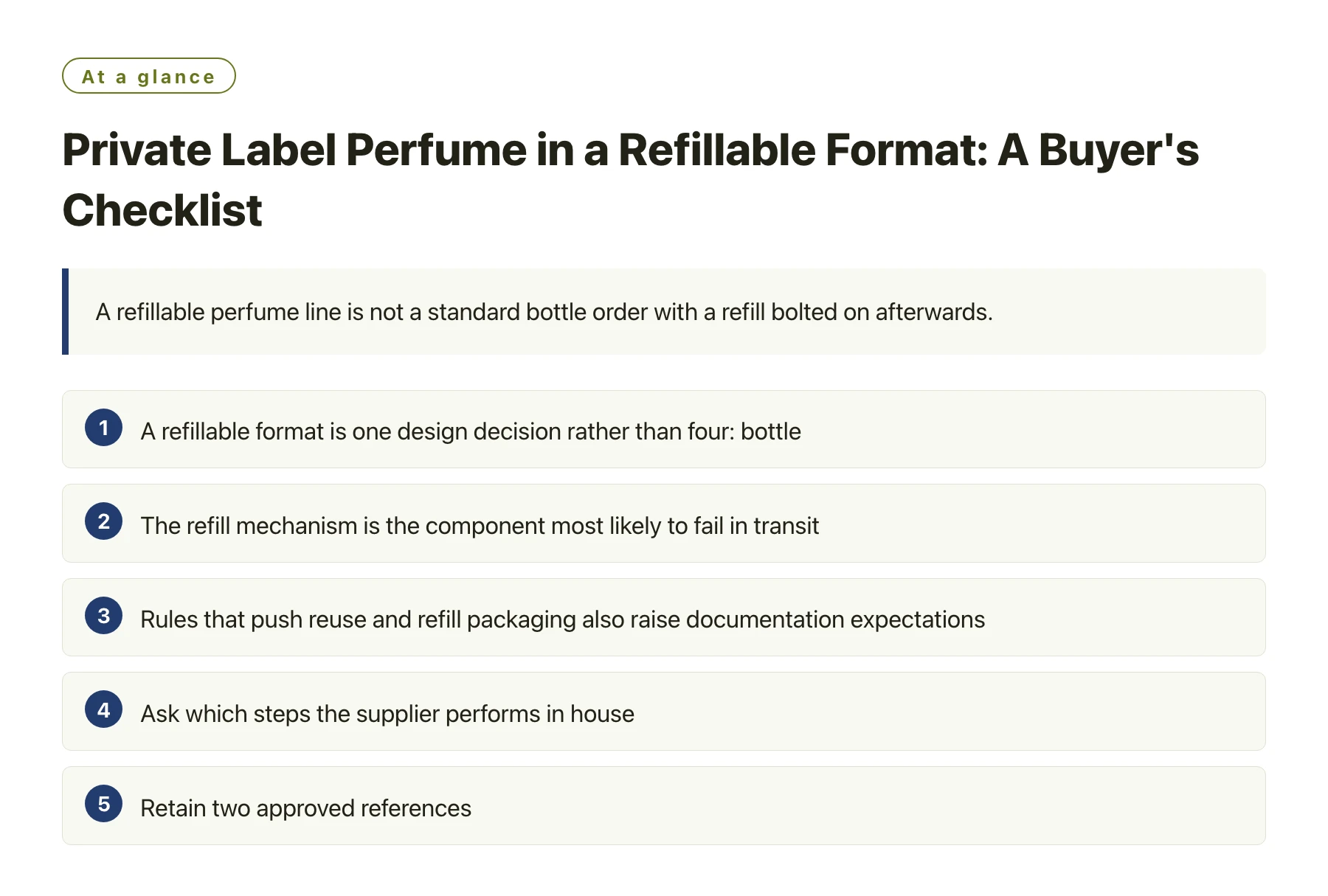
Key takeawaysA refillable format is one design decision rather than four: bottle, refill vessel, closure and outer pack have to be specified together. · The refill mechanism is the component most likely to fail in transit, so leak and drop testing belongs on the filled refill, not only on the primary bottle. · Rules that push reuse and refill packaging also raise documentation expectations, and those obligations sit with the brand that places the product on the market [1]. · Ask which steps the supplier performs in house, because that single answer determines lead time and where quality problems will surface. · Retain two approved references, one for the bottle and one for the refill, each labelled with a date and a batch number, before the bulk order is placed.
Refill formats get introduced for one of two reasons: a positioning claim about waste, or a practical one about keeping a customer inside a scent they already like. Both reasons change the purchasing brief, and neither is served well by treating the refill as an accessory.
Buyers rarely struggle because packaging options are scarce. They struggle because the refill decision was made after the bottle was approved, which means the closure thread, the pump collar and the carton were already locked.
Why a refill changes the brief
On a conventional fragrance order the bottle does most of the work. It holds the liquid, carries the label and provides the surface the consumer handles. A refillable product splits those jobs between two objects, and the split is where the engineering questions appear: does the refill seat into the bottle, or does the consumer pour from it, and who guarantees that the second fill behaves like the first?
That is a formulation question as much as a packaging one. A concentrate designed for a sealed spray does not automatically suit a format that gets opened, reseated and handled more often, because the liquid meets more air. Refill lines therefore tend to favour stability over novelty, and concentration is best chosen with the refill path in mind how fragrance concentration changes performance.
Start with the consumer action
Write down exactly what the customer does: unscrew, pour, click, reseat, discard the pouch. Every one of those verbs becomes a test case. Suppliers shown the action sequence early tend to flag mechanical problems while the design is still cheap to change.
Decide who owns the refill
Some brands sell the refill themselves, some hand it to retail partners, and some run it as a subscription. Each route changes the pack, the barcode and the paperwork, so settle it before the artwork is drawn rather than after.
The verification order that saves money
| Checkpoint | What good looks like | Why it matters |
|---|---|---|
| Refill mechanism | One defined action, tolerances written down | Ambiguity here becomes a leak complaint later |
| Closure and pump | Tested as a pair, not as two separate parts | Threads and collars interact, so testing them apart hides the failure |
| Compatibility | Refill tested in the bottle it is sold with | Cross-format refills invite returns and safety questions |
| Leak and drop | An agreed protocol on the filled refill | The refill travels further and rougher than the bottle |
| Label and carton | Text that survives handling and stays legible | Refill packs get handled more, not less |
| Retained samples | Bottle and refill references, both signed | A dispute needs a physical object to point at |
The order matters because the first two rows constrain everything below them. Approving artwork before the mechanism is fixed is the most common way a refill project loses a month.
Choosing the partner for the work
Private label means the product carries your name and the specification is largely yours, but the manufacturing decisions stay with the supplier. That makes the scope conversation unusually important. Ask for a written list of what happens on site and what is bought in, because a refill line usually needs filling, assembly and leak testing under one quality system rather than three.
A supplier set up for private label fragrance production should be able to describe that scope on a single page: compounding, filling, assembly, testing, decoration and packing, with subcontracted steps named. A vague answer is not automatically disqualifying, but it does tell you where to aim your own inspection.
It is also worth asking how many formats the supplier has taken through a refill programme, and in which markets. Experience with a screw-top decanter does not transfer automatically to a click-in refill, and the differences show up in the tooling schedule rather than in the quotation.
Send the brief in writing, to more than one supplier
Send three suppliers the same short brief and compare the answers line by line: which steps are in house, what the refill is filled on, how leak testing is done, what a retained sample looks like, and which documents ship with the first order. That comparison is more useful than any brochure, and it takes an afternoon.
From brief to bulk order, in the order that works
- Define the formatBottle, refill, closure, pack and consumer action, written as one page.
- Fix the filling routeDecide what is filled where, because it sets the sampling plan and the tooling.
- Sample both partsSample the bottle and the refill together, since a bottle sample on its own proves very little.
- Agree the test protocolLeak, drop, compatibility and ageing, with pass criteria written before the first test runs.
- Sign the referencesTwo retained samples, two batch numbers, one date, with both parties holding a set.
- Release artwork lastOnly once the mechanism is frozen, so the label does not describe a pack that has changed.
The most useful thing a buyer can do on a refillable project is to freeze the mechanism early. Artwork, carton, label text and even the marketing claim are cheap to change until the closure is tooled. After tooling, the same change costs time and a fresh round of testing.
Where the paperwork lands
The brand that places a refillable product on the market carries the obligations that come with it: a safety assessment, a product information file and ingredient disclosure in the markets that require it. Refill formats add a second layer, because the pack itself may be regulated as packaging with reuse or recyclability requirements.
Reuse is not automatically the lower-impact option either, because material choice and pack weight decide that, and design guidance for recyclable and reusable packaging is published openly by industry bodies such as the Sustainable Packaging Coalition [2]. A refill that doubles the pack weight can undo the claim it was built on.
None of this is exotic, but it goes more smoothly when the supplier's documentation habits are already good. A factory that keeps batch records, material declarations and test reports in a form you can hand straight to an importer will save weeks of correspondence, and the same discipline tends to show up on the filling line.
One practical habit: keep a single page per SKU listing every document, its date and who holds it. Refill programmes accumulate versions quickly, and that page is what stops an old safety assessment being sent to a new market.
This is also where a partner earns its keep. The choosing a private label perfume partner is usually the one whose paperwork arrives without being chased, because the same discipline that produces clean batch records also produces clean shipping documents.
Sources
- European Commission: Packaging Waste and the PPWR —— EU rules on packaging and packaging waste, including the Packaging and Packaging Waste Regulation requirements on recyclability and design.
- Sustainable Packaging Coalition —— A membership organisation working on more sustainable packaging design, publishing material and recyclability guidance.
Frequently asked questions
Is a refillable format more expensive per unit?
Usually yes at first, because two components, two test protocols and more assembly are involved. The comparison changes with volume and with how the refill is priced to the consumer, which is a commercial decision rather than a manufacturing one.
Can I use the same formula in the bottle and the refill?
Often yes, but confirm it rather than assume it. The refill may meet more air and handling, and the stability and compatibility work should cover that path specifically.
Who tests the refill, the brand or the factory?
It is normally shared. The factory tests what it controls on its own line, and the brand or its importer arranges any market-specific assessment. Agree the pass criteria before either side runs a test.
How many suppliers should I ask for a quote?
Three is usually enough to compare scope, tooling and documentation without turning the exercise into a full tender. Send an identical written brief so the answers are comparable.
What belongs in the retained sample set?
A filled bottle and a filled refill from the approved run, each labelled with date, batch and formula reference, held by both parties. A photograph is not a reference standard.