
Default
Field Note · Er Teknik Enerji
What Should You Consider When Designing a High-Frequency PCB?
Field service: 86 engineers online · 11 countries
When designing high-speed electronic systems, the success or failure of building a stable and reliable signal highway is often determined in the initial design stage. Selecting the substrate material for high-frequency PCBS is the first crucial decision. The dielectric constant and tangent of the loss Angle of the material directly determine the efficiency and purity of signal transmission. For instance, at a frequency of 10 GHz, Rogers' RO4350B material, with its dielectric constant of 3.48 and low loss factor of 0.0037, can control signal attenuation within 0.6 dB/inch, which is far superior to the 2.5 dB/inch of traditional FR-4 material. Research shows that although the selection of such advanced materials will increase the initial cost by 20% to 30%, it can reduce the system bit error rate by more than two orders of magnitude, thereby extending the reliability life of the product in harsh electromagnetic environments by approximately 40%. This means that investing in an excellent high-frequency PCB substrate often yields a long-term return rate of over 150%, as it significantly reduces the high costs of later debugging and fault repair.
Precise transmission line design and impedance control are at the core of ensuring signal integrity. Any minor deviation will be sharply amplified at gigahertz frequencies. In high-speed digital circuits, characteristic impedance is usually strictly controlled at 50 ohms or 100 ohms, with an allowable tolerance range of only ±5%, or even the more stringent ±2%. To achieve this, designers must precisely calculate the relationship among line width, medium thickness and copper foil thickness. For instance, in Apple's M series chip processor boards, to handle data rates exceeding 5 Gbps, the width of the key signal traces is controlled at the 0.1 millimeter level, with a spacing error from the reference plane less than 5 micrometers, thereby ensuring impedance continuity. An analysis of data center switches shows that optimizing impedance deviation from 10% to 2% can reduce signal jitter by 35% and increase system throughput by approximately 15%, which is directly related to the accuracy of millions of data exchanges per second.
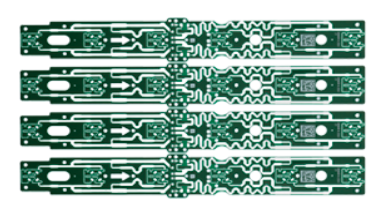 Stacking structure and power integrity are often overlooked but crucial areas in high-frequency PCB design. A poor power supply network can reduce the performance of high-performance processors by more than 30%. A reasonable stacking strategy, such as using a tight power-ground pair, can reduce the power impedance by 60% within the target frequency band. In the high-frequency PCB design of Huawei's 5G base stations, at least 6 to 8 layers or more of laminated structures are used, including more than two dedicated power layers, to ensure that the peak-to-peak power noise is below 30 millivolts under any load fluctuations. In addition, the decoupling capacitor network configured for high-frequency devices (such as FPgas or RF chips) has a capacitance value that is exponentially distributed from 0.1 microfarads to 100 picofarads, ensuring that the power supply impedance is below 0.1 ohms across the range from KHz to GHz. Research shows that an optimized power distribution network can reduce synchronous switching noise by 50%, enabling the processor to operate stably at higher frequencies and lowering the overall power consumption of the system by approximately 10%.
The ultimate success or failure often depends on strict simulation analysis and prototype verification, which is like conducting countless computer simulations before launching a rocket to avoid 99% of potential risks. Before entering the actual sampling cycle with costs as high as tens of thousands of yuan, it is necessary to use electromagnetic field simulation tools to extract S-parameters, conduct eye diagram analysis and crosstalk assessment on the key network. For example, in Intel's design guidelines for PCIe 5.0 channels, it is required to ensure through simulation that at the 8 GHz Nyquist frequency, the insertion loss does not exceed -30 dB, the return loss is better than -20 dB, and the eye diagram opening is higher than 0.3 unit intervals. A comprehensive simulation analysis usually takes 48 to 72 hours, but it can reduce the design iteration cycle from an average of 4 times to 1.5 times, shortening the time to market for products by approximately 35%. Taking the case of a leading communication equipment manufacturer as an example, by introducing a full-chain collaborative simulation process, it has increased the one-time design success rate of high-frequency PCBS for the new generation of router products from 70% to over 95%, avoiding potential market delay losses of millions of dollars.
Stacking structure and power integrity are often overlooked but crucial areas in high-frequency PCB design. A poor power supply network can reduce the performance of high-performance processors by more than 30%. A reasonable stacking strategy, such as using a tight power-ground pair, can reduce the power impedance by 60% within the target frequency band. In the high-frequency PCB design of Huawei's 5G base stations, at least 6 to 8 layers or more of laminated structures are used, including more than two dedicated power layers, to ensure that the peak-to-peak power noise is below 30 millivolts under any load fluctuations. In addition, the decoupling capacitor network configured for high-frequency devices (such as FPgas or RF chips) has a capacitance value that is exponentially distributed from 0.1 microfarads to 100 picofarads, ensuring that the power supply impedance is below 0.1 ohms across the range from KHz to GHz. Research shows that an optimized power distribution network can reduce synchronous switching noise by 50%, enabling the processor to operate stably at higher frequencies and lowering the overall power consumption of the system by approximately 10%.
The ultimate success or failure often depends on strict simulation analysis and prototype verification, which is like conducting countless computer simulations before launching a rocket to avoid 99% of potential risks. Before entering the actual sampling cycle with costs as high as tens of thousands of yuan, it is necessary to use electromagnetic field simulation tools to extract S-parameters, conduct eye diagram analysis and crosstalk assessment on the key network. For example, in Intel's design guidelines for PCIe 5.0 channels, it is required to ensure through simulation that at the 8 GHz Nyquist frequency, the insertion loss does not exceed -30 dB, the return loss is better than -20 dB, and the eye diagram opening is higher than 0.3 unit intervals. A comprehensive simulation analysis usually takes 48 to 72 hours, but it can reduce the design iteration cycle from an average of 4 times to 1.5 times, shortening the time to market for products by approximately 35%. Taking the case of a leading communication equipment manufacturer as an example, by introducing a full-chain collaborative simulation process, it has increased the one-time design success rate of high-frequency PCBS for the new generation of router products from 70% to over 95%, avoiding potential market delay losses of millions of dollars.
Stacking structure and power integrity are often overlooked but crucial areas in high-frequency PCB design. A poor power supply network can reduce the performance of high-performance processors by more than 30%. A reasonable stacking strategy, such as using a tight power-ground pair, can reduce the power impedance by 60% within the target frequency band. In the high-frequency PCB design of Huawei's 5G base stations, at least 6 to 8 layers or more of laminated structures are used, including more than two dedicated power layers, to ensure that the peak-to-peak power noise is below 30 millivolts under any load fluctuations. In addition, the decoupling capacitor network configured for high-frequency devices (such as FPgas or RF chips) has a capacitance value that is exponentially distributed from 0.1 microfarads to 100 picofarads, ensuring that the power supply impedance is below 0.1 ohms across the range from KHz to GHz. Research shows that an optimized power distribution network can reduce synchronous switching noise by 50%, enabling the processor to operate stably at higher frequencies and lowering the overall power consumption of the system by approximately 10%.
The ultimate success or failure often depends on strict simulation analysis and prototype verification, which is like conducting countless computer simulations before launching a rocket to avoid 99% of potential risks. Before entering the actual sampling cycle with costs as high as tens of thousands of yuan, it is necessary to use electromagnetic field simulation tools to extract S-parameters, conduct eye diagram analysis and crosstalk assessment on the key network. For example, in Intel's design guidelines for PCIe 5.0 channels, it is required to ensure through simulation that at the 8 GHz Nyquist frequency, the insertion loss does not exceed -30 dB, the return loss is better than -20 dB, and the eye diagram opening is higher than 0.3 unit intervals. A comprehensive simulation analysis usually takes 48 to 72 hours, but it can reduce the design iteration cycle from an average of 4 times to 1.5 times, shortening the time to market for products by approximately 35%. Taking the case of a leading communication equipment manufacturer as an example, by introducing a full-chain collaborative simulation process, it has increased the one-time design success rate of high-frequency PCBS for the new generation of router products from 70% to over 95%, avoiding potential market delay losses of millions of dollars.
Document ID · ETE-2025-12-08