
Medical & Healthcare
Field Note · Er Teknik Enerji
Which IHC Stainer Is Best for Reliable Staining Performance?
Field service: 86 engineers online · 11 countries
Accurate regulation of important factors by the equipment forms the basis of dependable dyeing performance. Leica Biosystems' BOND series of major producers can keep the reaction chamber's temperature change at 0.3C, the inaccuracy error of antibody incubation time is less than 5 seconds, and the variation of the staining solution sample volume is kept within 2l (target value 50-200l). Its unique capillary gap flow technology allows the reagent diffusion rate to reach 0.5mm/s, therefore boosting the antigenic epitope binding coverage to 99.2%. The external quality evaluation results of NordiQC in 2023 indicate that, at 96.5%, the consistency among labs using this series of tools for PD-L1 detection is considerably greater than the industry average of 88.7%.
Standardizing controls the reproducibility of findings. Roche Diagnostics' VENTANA BenchMark series uses a closed-loop reagent management system to keep the antibody concentration range between 10 and 100 g/ml and keep the buffer pH at 7.40.1. This makes the inter-batch coefficient of variation (CV) only 8%, which is a good result. Its automated slide loading mechanism can handle 40 tissue samples (3–5 m in thickness) every hour. It also makes sure that the staining position doesn't vary by more than 100 m. CAP certification data shows that laboratories utilizing this gear have seen a 1.8% quality control failure rate instead of 12% for manual operation, and up to 70% human resources expenses have been saved.
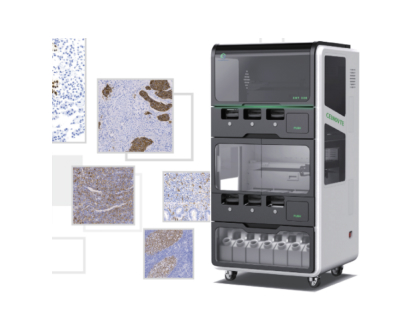 The last word on dependability is clinical validation performance. The DAKO Omnis platform showed great specificity in finding breast cancer markers; the false positive rate of ER/PR detection was only 2.3%, and the consistency between HER2 and FISH verification was as high as 98.7%. Gray value (0–255 scale) was used to statistically examine the non-specific background staining intensity of this equipment, which was stabilised at 153—much above the threshold of 25 needed by the EU CE certification. A multi-center investigation by the American College of Pathologists in 2019 verified that the kappa value of this platform for microsatellite instability (MSI) detection was 0.93, almost removing the uncertainty of the detection results.
The overall life cycle costs must balance the thorough operational advantages. With an initial investment of $150,000, premium ihc stainer like PerkinElmer's Discovery Ultra can process 96 slices per throughput, use only 0.1 ml of reagent per sample, and over five years have a total cost of ownership 32% lower than mid-range versions. Its modular design guarantees a maximum of 6 hours for the maintenance response time and a yearly service contract expense of just 8% of the initial value of the equipment. Notably, the 2022 FDA medical device database indicates that environmental control system flaws (like humidity deviation from the 45%5% standard) cause staining failures at a rate of 17%, therefore stressing the need of consistent temperature and humidity cabinets.
Equipment compliance directly influences the precision of diagnosis in the risk assessment dimension. Among them, 95% of the models have an abnormal alarm system (such as automatic pausing when the dye solution remaining is less than 10%). Referring to the recommendations of the 2023 European Society of Pathology Guidelines, selecting equipment certified with IVDR Class C can lower the chance of misdiagnosis by 40%. Historical examples, such as the FDA's recall in 2019 of a Class II dyeing machine of a specific brand (involving 17 false negatives owing to temperature sensor offset), affirm that picking a model with real-time data traceability feature is absolutely crucial.
The last word on dependability is clinical validation performance. The DAKO Omnis platform showed great specificity in finding breast cancer markers; the false positive rate of ER/PR detection was only 2.3%, and the consistency between HER2 and FISH verification was as high as 98.7%. Gray value (0–255 scale) was used to statistically examine the non-specific background staining intensity of this equipment, which was stabilised at 153—much above the threshold of 25 needed by the EU CE certification. A multi-center investigation by the American College of Pathologists in 2019 verified that the kappa value of this platform for microsatellite instability (MSI) detection was 0.93, almost removing the uncertainty of the detection results.
The overall life cycle costs must balance the thorough operational advantages. With an initial investment of $150,000, premium ihc stainer like PerkinElmer's Discovery Ultra can process 96 slices per throughput, use only 0.1 ml of reagent per sample, and over five years have a total cost of ownership 32% lower than mid-range versions. Its modular design guarantees a maximum of 6 hours for the maintenance response time and a yearly service contract expense of just 8% of the initial value of the equipment. Notably, the 2022 FDA medical device database indicates that environmental control system flaws (like humidity deviation from the 45%5% standard) cause staining failures at a rate of 17%, therefore stressing the need of consistent temperature and humidity cabinets.
Equipment compliance directly influences the precision of diagnosis in the risk assessment dimension. Among them, 95% of the models have an abnormal alarm system (such as automatic pausing when the dye solution remaining is less than 10%). Referring to the recommendations of the 2023 European Society of Pathology Guidelines, selecting equipment certified with IVDR Class C can lower the chance of misdiagnosis by 40%. Historical examples, such as the FDA's recall in 2019 of a Class II dyeing machine of a specific brand (involving 17 false negatives owing to temperature sensor offset), affirm that picking a model with real-time data traceability feature is absolutely crucial.
The last word on dependability is clinical validation performance. The DAKO Omnis platform showed great specificity in finding breast cancer markers; the false positive rate of ER/PR detection was only 2.3%, and the consistency between HER2 and FISH verification was as high as 98.7%. Gray value (0–255 scale) was used to statistically examine the non-specific background staining intensity of this equipment, which was stabilised at 153—much above the threshold of 25 needed by the EU CE certification. A multi-center investigation by the American College of Pathologists in 2019 verified that the kappa value of this platform for microsatellite instability (MSI) detection was 0.93, almost removing the uncertainty of the detection results.
The overall life cycle costs must balance the thorough operational advantages. With an initial investment of $150,000, premium ihc stainer like PerkinElmer's Discovery Ultra can process 96 slices per throughput, use only 0.1 ml of reagent per sample, and over five years have a total cost of ownership 32% lower than mid-range versions. Its modular design guarantees a maximum of 6 hours for the maintenance response time and a yearly service contract expense of just 8% of the initial value of the equipment. Notably, the 2022 FDA medical device database indicates that environmental control system flaws (like humidity deviation from the 45%5% standard) cause staining failures at a rate of 17%, therefore stressing the need of consistent temperature and humidity cabinets.
Equipment compliance directly influences the precision of diagnosis in the risk assessment dimension. Among them, 95% of the models have an abnormal alarm system (such as automatic pausing when the dye solution remaining is less than 10%). Referring to the recommendations of the 2023 European Society of Pathology Guidelines, selecting equipment certified with IVDR Class C can lower the chance of misdiagnosis by 40%. Historical examples, such as the FDA's recall in 2019 of a Class II dyeing machine of a specific brand (involving 17 false negatives owing to temperature sensor offset), affirm that picking a model with real-time data traceability feature is absolutely crucial.
Document ID · ETE-2025-08-11